

Hanna Budny, owner of The Offy in District 1881. (Credit: Havens House Photographic)
A conversation with Hanna Budny rarely stays on one subject for long.
A fig becomes an ecosystem. A restaurant becomes a school. A move to Chilliwack becomes a lesson in presence. A relationship that has ended becomes an opportunity to think about love without reducing it to success or failure.
The connections might initially seem unexpected, but Budny sees them everywhere. It is also the best way to understand The Offy, the playful European-inspired restaurant she opened in Chilliwack’s District 1881 nearly four years ago.
The food and drinks matter deeply to her, of course. But they are also the beginning of something larger.
“I think it’s not necessarily food and drink, although I love and I’m obsessed with food and drink,” Budny says. “It really is about the power of food and drink and how it has the power to actually connect people.”
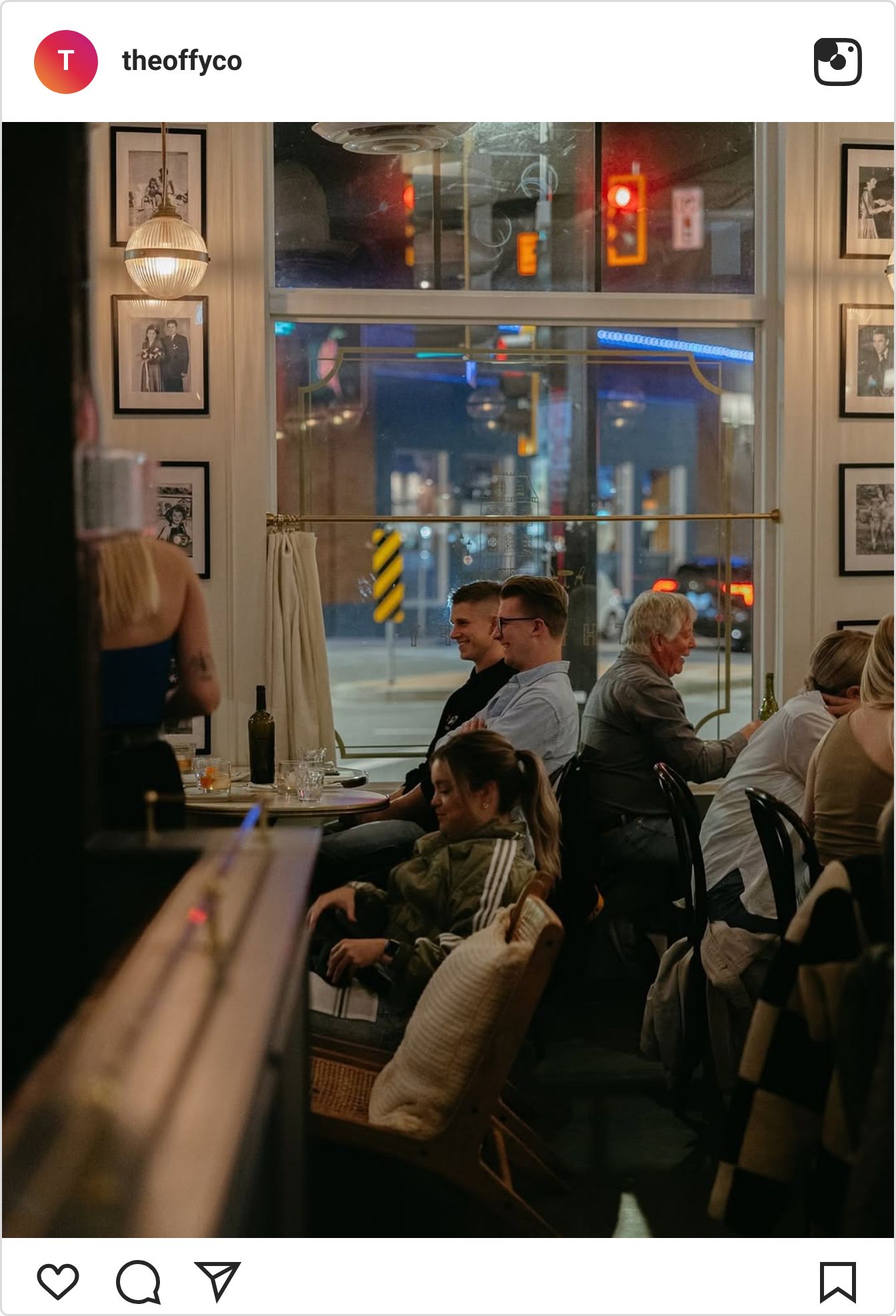
That idea is visible throughout The Offy. During the day, it operates with the brighter energy of a café and brunch spot. At night, it shifts into a dinner restaurant and cocktail bar. Its menu moves through European influences without committing itself entirely to one country, while the room is filled with unusual paintings, cheeky glassware, and objects that seem designed to make people ask questions.
Budny describes the restaurant almost as a living ecosystem: staff, customers, suppliers, friends, and strangers all contributing to the atmosphere and forming relationships around food and drink.

The Offy is approaching its 4th anniversary. (Image Supplied)
“It’s like a little world,” she says. “Everyone is part of it.”
It is a deeply personal vision, but Budny arrived at it through years spent inside much larger hospitality operations.
Born in Poland, she eventually immigrated to Canada with her family after an early and difficult attempt to establish themselves in Athens. Her parents were entrepreneurial out of necessity. In Poland, they found ways to make extra money by selling fruit. In Canada, her mother built a cleaning business and her father started a flooring company.
Budny began working in restaurants at 14. While studying food science at UBC, she continued serving before joining Browns Socialhouse, where she moved through nearly every conceivable position: host, expo, server, bartender, general manager, and eventually a regional role.
During her years with the company, she helped open more than 30 restaurants across Canada and the United States. She worked on training systems and helped guide incoming owners, operators, and chefs through the company’s pipeline. Later, she worked with Tap & Barrel as it opened Brehall in Vancouver.
She became fascinated by the discipline required to build not merely one restaurant, but an entire organization.
“There’s a level of skill that comes along with that,” she says. “A level of tenacity, perseverance, focus, intentionality. It’s a machine—but a human one.”

“I’ve never made so many mistakes in my life,” Budny says. “I think people on the outside see success or branding or social media, but it’s really hard. We’re humans too, as entrepreneurs.” (Credit: Havens House Photographic)
Outside work, Budny pursued a different kind of hospitality education.
She lived in Vancouver for more than a decade, immersing herself in the city’s restaurant culture. After completing clusters of openings, she would take extended trips abroad. She spent time in Chianti learning about wine and lived with a family at a Piedmont winery during harvest season, learning about Barolo and truffles.
Her travel was frequently organized around restaurants, cafés, bakeries, and wineries, although “organized” may be too strong a word. She preferred allowing one encounter to lead to another.
On her first adult trip to Europe, at 18, she and a high-school friend travelled to Spain. They would visit a local restaurant, ask where its owners liked to eat, follow the recommendation, and then ask someone there where they should go next.
“We didn’t plan anything,” she says, laughing. “We just followed people.”
A plan for dinner could turn into a seven-hour journey ending in a friendship that lasted years.
“That’s what food does,” she says. “It opens doors you didn’t know were there.”
It could provide a reason for people to sit together for hours. It could create a path into a culture. It could connect a traveller to a restaurant owner, who connected them to a bartender, who connected them to someone else.
This European understanding of hospitality—long meals, multiple courses, sustained conversation—would later become foundational to The Offy. But Budny had to leave the restaurant industry before she fully understood why she belonged in it.
Around seven years ago, she left her corporate job and bought a one-way ticket to Bali. She stayed for four months, completed yoga-teacher training, and learned to surf, partly because she could not stand that she had failed to get onto the board during her first attempt.

“I heard no a lot,” Budny says. “A lot.” (Imaged Supplied)
“I’m very stubborn,” she says. “If I can’t do something, I have to figure it out.”
She intended to leave hospitality behind. She launched an e-commerce company selling products such as scrapbooks online and returned to Canada to establish its banking and operations.
Then the pandemic arrived, and Budny discovered that the freedom of an online business came with a major drawback: she did not want to spend her life alone in front of a computer.
“I love people,” she says simply. “I really do.”
The detour gave her skills that would later help her operate The Offy, but more importantly, it clarified what she had been missing. She did not simply love restaurants because she was interested in wine, food, or service. She loved what happened between people inside them.
Opening one herself, however, was far harder than helping other owners open theirs.
Budny approached nearly every bank she could think of. Nearly all of them rejected her. Restaurants were an especially difficult proposition in the period following the pandemic, and lenders had become even more cautious about new hospitality businesses.
“I heard no a lot,” she says. “A lot.”
Eventually, a woman at BMO took the time to look further into Budny’s plan and experience. She called references, considered Budny’s history in the industry, and helped move the application through a rigorous process.
Financing from the bank and a government-backed program covered much of the build. Budny also borrowed from her parents’ retirement savings.
She now recognizes that a degree of naïveté may have been necessary.
“If I knew all the things that would come along this journey,” she says, “I don’t necessarily know if my brain would have the capacity to sit with all that and then be like, ‘Can I handle all these things?’”
Her experience had taught her how restaurants function. Ownership taught her what it feels like when every decision, mistake, conflict, expense, and livelihood ultimately arrives at your feet.
Budny calls the restaurant an “earth school.”
“I’ve never made so many mistakes in my life,” she says. “I think people on the outside see success or branding or social media, but it’s really hard. We’re humans too, as entrepreneurs.”
She pauses again. “And it’s humbling. Every day.”

It took time for Budny to warm up to Chilliwack, but now the city has impacted her just as much as she has impacted it. (Credit: Havens House Photographic)
The result has been professional growth, but Budny describes the change in more expansive terms: learning, healing, and a transformation of beliefs that once protected her but no longer served her.
Her relationship with Chilliwack has undergone a similar transformation.
“When I first moved here, I hated it,” she says, frankly.
Having grown accustomed to Vancouver’s restaurants, cafés, fitness studios, events, bike rides, and constant activity, she struggled to understand what people did in Chilliwack. The city was also different six or seven years ago. District 1881 did not yet exist in its current form, and many of the businesses that now make Chilliwack’s food and drink scene feel dynamic had not opened.
Budny had initially viewed the move as temporary. She would develop her e-commerce business and eventually return to Bali.
Instead, she met someone, remained in the community, and eventually opened The Offy. She now says she would not return to living in the city.
Chilliwack forced her to slow down. She began sitting by the river and walking the dike. She noticed the trees, berries, farms, and natural abundance around her. Without the same constant motion, she began hearing her own thoughts more clearly.
“The slower pace forced me to become more present,” she says. “And when I become more present, or I am more present, I am more free.”
Chilliwack changed Budny. Through The Offy, she has also helped change Chilliwack.
The restaurant introduced a European-style experience that did not neatly resemble what already existed in the city. Early guests encountered spritzes, wine flights, unfamiliar products, and a room that felt both elevated and deliberately strange.
Budny was determined to create something European-inspired, even if she did not know whether Chilliwack was ready for it.
“I just wanted it to feel like somewhere else for a moment,” she says.
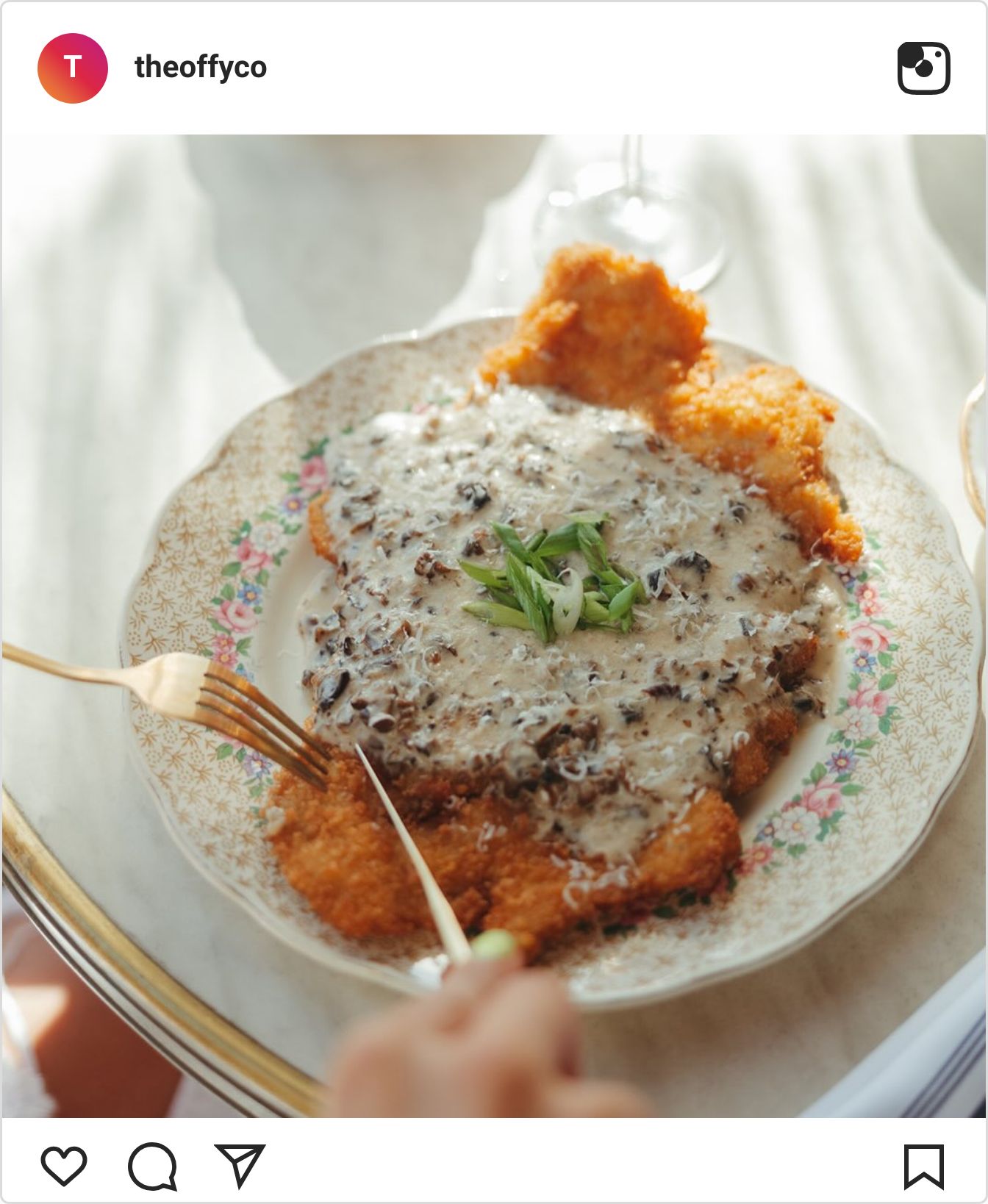
The menu has included Polish dishes such as schnitzel and pierogies alongside ideas gathered from Italy, France, Spain, and elsewhere. Approximately 99 per cent of what the restaurant serves is made in-house, Budny says, and its bar program prioritizes quality spirits, including local producers when possible.

The Offy’s patio is a popular and scenic rendezvous for locals and visitors alike. (Credit: William Johnson)
Yet The Offy does not treat that quality with solemnity.
“We’re not saving lives,” she says with a smile.
The restaurant may serve serious cocktails, but it might serve one in a mug shaped like certain body parts of woman. The design is intended to create curiosity rather than intimidation. Budny wants staff to guide guests through an experience, not simply take an order and deliver a bill.
“People should feel taken care of,” she says. “Not processed.”
She has also learned when to adjust. The menu has evolved according to what the community responds to, requiring her to separate her own ego from the realities of operating a business.
Her method, she jokes, has often been to throw things against the wall, see what sticks, and repeat the process.
“That’s kind of my strategy,” she says. “Try it. Learn. Adjust.”
That process has sustained The Offy as it approaches its fourth anniversary this November. Budny can imagine opening another location—perhaps even two—but she does not yet know exactly what that would look like. Any future Offy would have to retain its individuality rather than becoming a copy of the original.
“I don’t want clones,” she says. “That would defeat the purpose.”
She is comfortable not having the answer.
“Maybe I’ll figure it out on a walk,” she says.
Perhaps, she suggests, it will come to her while she is walking along the dike.
After four years spent learning to make mistakes, listening to herself, and remaining open to where one connection might lead, that seems appropriate.
